Advent Day 3

Advent Day 3:  Prayer

And suddenly there was with the angel a multitude of the heavenly host,  praising God and saying,
   “Glory to God in the highest heaven,
   and on earth peace among those whom he favors!”   (Luke 1:14)  

Ah, the dreaded outline.  Did you ever have to make an outline for a class:  an outline of a paper, or of a chapter you read in your textbook?  Boring, huh? 

Yet I think the opposite can be true for prayer.  Sometimes we just have no idea what to say to God.  If you’ve ever experienced a lack of words (or if you think your words are getting in the way), try “outlining” your prayer.   It may feel fake at first, but after a while it may help you guide your thoughts.  Here are some suggested outlines, and you can make up your own.

“ACTS” outline:  this contains all the elements of the Lord’s Prayer, by the way.  I’ll write more about the Lord’s Prayer in a later post.

Adoration:   praising God.  Begin your prayer by reflecting on what’s great about God.  My experience using this outline is that this is the most difficult step.  What can I say that doesn’t sound cheesy, or hasn’t been said better by someone else?  Sometimes for this step I just sit and enjoy God’s presence, to help me stop worrying about what to say and to put me in the right frame of mind for prayer.  Or, I repeat the words to a hymn or praise song.

Confession:  letting go of whatever you did wrong and asking for forgiveness and restoration.

Thanksgiving:  just like what it says.  Give thanks to God.

Supplication:  this means asking for things.  It’s OK to ask for healing for sick people, and guidance for confused people, for world peace, and so on.  I don’t think supplication is about asking God for magic tricks.  Instead, sometimes as we pray over and over for something, we begin to see the world through God’s eyes, and we see how God is already answering our prayers.  Also, sometimes through supplication God helps us accomplish what we pray for.  Those who pray for peace may learn over time how to become peacemakers, for example.

“Breath Prayer” outline.  You can do this in one of two ways. 

First, you can say a word such as “ask” when you breathe out, and “receive” when you breathe in.  Other useful words:  peace, love, hope, Spirit, shalom, I, Thou, one, many.

Second, you can stretch the prayer out, spending some time looking inward and then considering the world around you.  I used to do this in a particular place I would walk every morning:  on the first half of the walk I would lift up whatever was going on in my life to God, and on the second half I would ask God for direction on how I would be a servant in God’s world that day.

May your prayers be like the breath of life.  (see Genesis 2.)

Today’s daily Scripture reading from the PC(USA):  http://gamc.pcusa.org/devotion/daily/2010/11/30/
Advent Day 2: Generosity

bringing offerings is futile;
     incense is an abomination to me. … 
cease to do evil, 
   learn to do good;
seek justice,
     rescue the oppressed,
defend the orphan,
     plead for the widow.  (from Isaiah 1)

Today is Cyber Monday, a new holiday shopping trend geared for the buyer of technology.  (Did it ever occur to anyone that most of us are supposed to be at school or work today?  Well, I suppose that since we can carry work into our free time thanks to the Internet, why not take online shopping to work?)

To be fair, I am doing Christmas shopping too, although probably not today.  Of course I want to give gifts to my loved ones, as a way of showing I care about them. 

You read it right.  I am planning to demonstrate my love through giving away material things.  Before you have a fit, let me ask you:  how else am I supposed to do it?  I can say “I love you” all day, but if my bills show that I only spend money on myself, those three words lose some of their luster.  This is about more than “having a Christmas spirit”:  it’s about thinking of others when you make financial commitments.  It’s about swiping your debit card on someone else’s behalf, instead of on another latte for yourself.

In chapter 1 of the book of Isaiah, the voice of God comes lashing out against the supposedly holy people, who praised God with fancy words and expensive rituals, but never took a moment to consider the needs of others.  In essence, God says, “Put your money where your mouth is.  Show me you love me by caring for my people.”

Today’s spiritual practice is generosity.  To me, generosity means showing you care in both word and deed (or word and wallet.) 

One way to practice generosity would be to make some donations this season.  Try the Heifer Project or the many microfinance programs available, which allow people to make use of existing technology and even develop their own.

Also try practicing generosity by giving meaningful gifts.  Give some careful thought to any gifts you buy this season:  are they useless, flashy junk, like the incense despised by God?  Or do they symbolize the sacrifices you make when you care for others?  And think about this too:  does going deep in debt at Christmas mean that you’re generous or irresponsible? 

Can you spend a month balancing word and wallet?

Today’s Scripture reading from the PC(USA):  http://gamc.pcusa.org/devotion/daily/2010/11/29/

Advent Day 1

Advent Day 1 :  Prepare the Way

A voice cries out:
In the wilderness prepare the way of the Lord,
make straight in the desert a highway for our God.  (Isaiah 40:3)

If you go to church this morning (depending on the church), you may hear some things you aren’t expecting to hear:  in particular, Advent music. What in the world is Advent music?   And where did my Christmas carols go?

Generally, Advent Scripture readings and music draw heavily from the prophets of the Bible and from Jesus’ own words about his return.  During the four Sundays of Advent, we’ll hear from people who preached about God’s plans for the world:  plans that included a baby and so much more.  We’ll hear from people who said, “Prepare the way!  God is getting ready to do tremendous things.”  Each year, pastors like me hope that by focusing on Advent, we will reawaken ourselves to the many ways God reaches out to us and dwells with us.

By the way, Christians who observe Advent aren’t necessarily anti-Christmas!  It’s just that we know we have some serious things to think about before Christmas comes.  After all, Christians claim that the little baby Jesus really is the Son of God, and that’s not a statement we can make lightly!  We ought to spend some time thinking about what it means for God to take up residence here on earth.

So today’s spiritual discipline is “getting ready” or “preparing the way.” Here’s an exercise for today:

Pretend that you live in a very small dorm room or apartment (perhaps you already do!)  You are notified that on Christmas morning, an important person will show up to stay at your home.  What do you need to do in order to get ready?  What needs to be cleaned or fixed?  How can you make your small space welcoming and inviting?  What food will you serve to your guest?  What would you like to talk about with him or her?  Apply these same questions to Christ.  How will you welcome him and serve him, though you may feel “small” in your spiritual life?  What will you talk about with Jesus?  What do you hope will happen during his stay?

Write these things in a journal and revisit your thoughts as Advent continues.

Today’s PC(USA) online Scripture readings:  http://gamc.pcusa.org/devotion/daily/2010/11/28/

Advent Devotional: Introduction

A while back, I went searching for devotionals for young adults that I would be happy to recommend to members of my church and campus ministry group.  I’m still looking, but so far have come up empty. 

At the same time, the members of the campus ministry group I direct were talking about ways they live out their spiritual life.  Spiritual practices, you might say.

So I decided that for the Christian season of Advent, a period of about one month, I would post one idea for spiritual practice per day on this blog.  You could call this little adventure a “devotional,” I suppose.  Some of the ideas are things you can do immediately, and others may require some planning.  Regardless, I hope something written here will speak to you.

If you do choose to take on some spiritual practices during Advent, you might want to keep a journal, or get some candles that you can light every day as you spend time with God.

For more information on the books I’ve used, please visit my “Resources” page (which I will add soon) and also look at my blogroll for more blogs on spiritual life.  (There are a ton of blogs out there on faith, spirituality, Bible study, and et cetera!  Happy reading!)

I have a few disclaimers as well:  few, if any, of these are original ideas.  This is simply a collection of ideas I’ve picked up along the way.  Many of these ideas appear in more than one source.  I have given credit wherever possible, usually from wherever I happened to find the idea.  If you have corrections or further details please email me.  Also, I have tried to avoid any “church words” that you may not know:  let me know if you have questions about something written here.  Finally, please note that I’m not an expert on spiritual disciplines or spirituality.  I just wanted to pass along some ideas that have been meaningful to me.

I sincerely hope you’ll find something here that leads you toward some of our great present-day teachers on Christian spirituality, and toward a deeper spiritual life. 

In faith,

Kerri

let’s go shopping

My daughter has a new fascination.  She picks up an old purse I gave her and says brightly, “Shopping!”

I was mortified when I first saw this.  Then I thought about it:  what do she and I do on the weekends?  We go on walks, go to playgrounds, eat, color, and shop.  My weekends are Fridays and Saturdays, so every Friday morning I make a grocery list and we head out to stock up for the week.  During the summer we make an additional trip to the produce stand or farmer’s market.  Sometimes we have additional trips to pick up diapers or finger paint.

This probably sounds terrible to you.  “What kind of parenting is going on here?  They shop all the time!” you might say.

Before you quit reading, however, let me ask you:  do you know what your grandmother, or great-grandmother, did when she wasn’t cooking or cleaning?  I’ll bet she shopped.  In fact, I’ll bet your male ancestors did a lot of shopping too.

For millenia, women, men, and children would grow stuff, make stuff, and journey to the local market to buy and sell stuff.  These were daily and weekly activities.  Many parts of the world still have strong traditions of farm and market.  Central to this older way of life are the acts of browsing, choosing, trading, haggling, and getting to know one’s partners in commerce.

Over time, people all over the income spectrum have lost the connections of the marketplace.  Hardly anyone in America knows where their food, clothing, furniture, dishes, or curtains were made.  Few Americans have to interact with anyone when they pick up their basic necessities.  If you need bread, you can ring up your own purchases at the self-checkout.

As Christmas approaches, I feel a return of that old anxiety about shopping.  Shopping is materialistic, we pastors cry every December.  I feel obliged in the coming weeks to deliver the annual rant about the evils of malls, credit cards, and Santa Claus.

Generally the pastors’ advice has been to consume less and donate more.  I think that’s fine advice, given that many Americans have way too much stuff and overwhelming debt.  Yet … may I go ahead and say that shopping at Christmastime could be a good idea?

What would happen if we went “to market” during this shopping season?  What if everyone who could get to a real bakery, deli, or artisans’ workshop actually went there and purchased things?  We would get to know our neighbors, and we would provide income in our local communities.  We would have a chance to investigate the quality of the product for ourselves, and to complain to the actual producer if something wasn’t right.  We could even provide the accountability we are currently missing in our mass-produced culture.  (If I bought dishes that were made far away and painted with a poisonous glaze, how could I complain and be sure my objection was heard?  But if I visit one of our great North Carolina potters and find my coffee mug to be gross–an unlikely scenario, but bear with me–I can go right to the source.)

Of course, not all Americans can afford the prices and gas money required to visit a local producer, and that’s part of the problem.  The real market isn’t accessible to everyone.    Yet I can do my small part to turn things around.  I’m not wealthy enough to keep all the local merchants in my hometown in business.  But I can think about where I shop before I crank the car.  I can sacrifice somewhere else in my budget in order to buy less junk.

Next time, my daughter and I will get our purses and head out to shop local.  I just found a store downtown that sells actual cloth diapers, and while we’re out we’ll visit an art store to get good crayons.  After that, we’re picking up our holiday pies at a real bakery.  See you there!


rock

My mom loves to say the Apostles’ Creed during Sunday worship.

Really? you may say. Usually people say their favorite part of a worship service was the prayer or singing or even the children’s moment that is popular in mainline churches.

Yeah, she likes the creed! It’s a touchstone for her, a place to stake her claim once a week in this crazy little thing called life. It’s a ritual that brings meaning and light.

I understand a lot of people resist creeds and religious rituals, worrying that if they participate in those things they’ll lose their independence. I understand the fear of indoctrination.

What I have trouble understanding is why people would resist having a touchstone or foundation in their lives. “I don’t need a crutch,” people sometimes say to me. Well, tonight I read a passionate essay from a punk rock artist who has rejected the idea of God– yet he writes about studying world religions and finding a home in music. He writes about growing up, and about what grounds him in his adult life. Sure, I wish he’d rethink some of his claims, but I appreciated his honest story about searching for something solid and meaningful.

At some point we’re all going to feel the ground shifting beneath us, literally or symbolically. It may even feel as though the ground has disappeared. Why would anyone reject a ledge to cling to at such a time?

It doesn’t bother me at all to use words that someone else wrote as part of my foundation. Honestly, I think if you polled people who say they feel grounded, you would find they are using words or ideas or traditions they didn’t create. When I really feel groundless, going back to Scripture or poetry or even good old theology texts renews my thinking. What dulls the blade for me is constant preoccupation with my own opinions (this blog not withstanding, wink wink.)

So where’s your rock? It could be right under your feet, but you were too busy looking for something more impressive, so you didn’t notice it. It could be a rock someone else already used and found to be steady. Why not try it out?

let’s talk

Today I had such a great day, because I got to talk to people.  I had at least half a dozen meaningful one-on-one conversations, and that’s what makes the day for me.  I had the opportunity to talk to students, church members, and even to a radio host to promote the upcoming CROP Walk for Hunger.

You just can’t beat a good face-to-face conversation. I love writing and I’m having fun with this blog, but without “face time” I think my writing would be meaningless.

I get nervous with a lot of email, texting, online comments, and what not.  Yes, it’s the way of the future.  However, if I can’t look into your eyes, hear your tone of voice, or read your body language, I really don’t know what we’re talking about.  I may misinterpret your tone or your posture or your gestures, but I think I can get it right the more we talk.

That’s why I feel so privileged to be a pastor.  I can take time to have real sit-down conversations.  And if I’ve had a conversation via phone or internet with someone and I don’t feel right about it, I can say, “Let’s meet face to face,” and people usually say OK.

Perhaps there are others who don’t thrive as much on face time as I.  And that’s OK.  I just hope they understand when I say, “Let’s talk.”

(PS:  I don’t have a lot of readers on this blog, but if you’re one of them, do me a favor.  Think about a good conversation you’ve had recently.  Think about what made it good.  And try to re-create those good elements next time you sit down and talk.)


Sabbath-keeping

Last month I meant to post some of the ideas the college students shared about keeping Sabbath time.  I think these are all great ideas for carving out a Sabbath in the midst of everything else. I guess the big challenge for students, and everyone really, is to make an even greater commitment to Sabbath and spiritual development.
Here goes:
  • Attend a meditative worship service (such as the Compline service sponsored by another local campus ministry)
  • Create a Sunday ritual, such as worship at the 11 am service and going out for a leisurely lunch afterward
  • Nature walks, or just quiet walks around campus during a less-busy time (but not at night!)
  • Healthy recreation, fun and games
  • Talking to God at night when you lie down in bed, until you drop off to sleep.  Pretty neat that your last thought before sleep is a prayer rather than a worry.
  • Reading good books and passing them around within your group of friends
  • A small group Bible study NOT led by an “expert”
  • Praying while you do menial everyday tasks
  • Listening to prayer podcasts (one student’s favorite is here (it’s called “Pray As You Go”)
I’ll post more as we continue to talk about this.

God moment

In Bill Moyers’ PBS series on Genesis, Dr. Renita Weems gives her definition of a miracle.  I don’t have her exact words, but she says that a miracle is receiving something you needed just when you needed it.  It may have another, more scientific explanation.  But to you, the miracle is God intervening in your life at a certain point in time, in such a way as to briefly erase the line between heaven and earth.  The modern parlance for miracle seems to be the term “God moment”:  I hear people using this term often to describe a moment when they were fulfilled, or made aware of God’s presence, or both.

Well, if there ever was a miracle, or a God moment, I’m watching it right now in a tiny window on my computer screen.  It’s been hard to sleep and work ever since the rescue of the Chilean miners began last night.

I realized this morning, after a few brief hours of sleep, how many “moments” I’ve seen unfold right before my eyes on live TV.  Some of these were miraculous, others disastrous.  In fact, just about my entire time in ministry has been punctuated by these huge moments that everyone gets to watch.  Here are a few items from my list:

  • September 11
  • The invasion of Iraq in 2003
  • Recent large-scale natural disasters (tsunami, Katrina, earthquake in Haiti, floods in Pakistan)  — even if TV crews weren’t there at the precise moment of disaster, they converged on the scene in record time.
  • And of course, the mine rescue.  I just can’t get over how calm the miners are as they wait those last few seconds in the capsule.  They wait with the patience of Job until they are unharnessed and able to kiss their loved ones.

Are all of these God moments?  In a way, yes.  In seminary we used to talk about “liminal moments”:  experiences that blur the boundaries between God and people, eternal and temporal, holy and ordinary.  A liminal moment is when something extraordinary is happening, and you sense the power of God in an overwhelming way.  You can have a liminal moment in a time of great rejoicing, or of deep suffering.

I think I need to pay more attention to these moments.  As long as we have instant access to photos and video from almost anywhere in the world, we’ll be able to watch as people experience life-changing moments.   And we’ll most likely feel intense emotion, even though we are far from the action.  (I wonder if TV also increases our feelings of empathy and the inevitable feelings of helplessness that go along with it.)  We have a totally new way of experiencing the presence of God, and I’m not totally sure what that means yet.  Through technology we are drawn in with others in a way that was impossible during the time of Abraham, David, Jesus, Paul, Constantine, or Luther (or Calvin!)  Would the founders of our faith know what to do with all this information?

Anyway, I’m going to quit writing so I can watch more miners emerge from the pit.  I’m anxious to see how this God moment develops, both in the lives of the people in Chile and in all those who are drawn in by TV and prayer.

Postscript:  here’s a link to a great photo page on CNN (scroll down until you see a photo of the back of a man wearing a beige T-shirt.)  If I’m translating it right, the back of the miner’s shirt reads:

“For the depths of the earth are in his hands, and the heights of the mountains are his.”  In Him is the honor and the glory.

just a little bit

I’ve always believed in the power of little things.  Yes, it sounds sentimental, like a motivational poster with a picture of a butterfly or something (“One little flutter of a butterfly’s wings….”) Blech.

It’s just that in my way of thinking, getting the big things right is impossible unless I start small.  And in my experience, if I forget about the small stuff, my whole life gets out of balance.

Over the weekend I found myself re-converted to my belief.  Last Thursday night, the college students shared ideas on taking a Sabbath rest.  (Most of the folks in the room admitted to already being tired this early in the semester!)

It struck me how all the ideas being batted around the room were so, well, little.  The activities the students described were rich and meaningful, but just … short.  This is no criticism of the students!  They are simply part of a larger society that seems to have no use for big commitments anymore.

In fact, as I mulled over our discussion, I remembered some other things I’ve read, suggesting that people of faith try something little.  Donna Freitas, author of Sex and the Soul: Juggling Sexuality, Spirituality, Romance and Religion on America’s College Campuses recommended in a recent interview* that students try temporary abstinence from sex.  She wondered if short periods of abstinence might lead to a greater commitment, once students have a breather from worrying about sexual performance and have a chance to rest in their own beds.  Somewhere else (but I can’t remember where) I read a suggestion that Christians try small bits of “fasting” or “abstinence” from things like TV or junk food.  Even the secular magazines I read regularly have articles about cutting down on meat or gasoline or some other commodity, but not cutting it out entirely.

Only one student in that group brought up the concept of a total Sabbath.  Her relatives had been farmers, and they took Sundays off. No cooking (cold leftovers for all three meals), no laundry, no cleaning.  They just got dressed, went to church, visited relatives, and probably washed the dishes.  (I can’t imagine a Southern woman leaving dishes in the sink overnight!)

Wow.  I guess this is where we are as a society.  Sometimes I think the only true commitment we make is to our cell phones.  We’re accessible 24/7, ready to go over tomorrow’s meeting with the boss while we cook dinner, or to check Facebook while we supposedly have lunch with our significant other.

Other than the phone, what commands our true commitment?  Work?  Hmm… everyone checks Facebook at work too.  Marriage?  I wonder if there would be so many marriage books on the market if couples just took a little more time to talk.  Taking care of our bodies?  As long as I can do it in 10 minutes or less!  Taking care of our souls?  Um, maybe later when things calm down at work/school/whatever.

Of course I still believe in the little things.  I really like Donna Freitas’ suggestion.  Also, later on, I’m going to post some of the Sabbath ideas shared by the students.  Maybe these little things can help us rearrange our commitments.

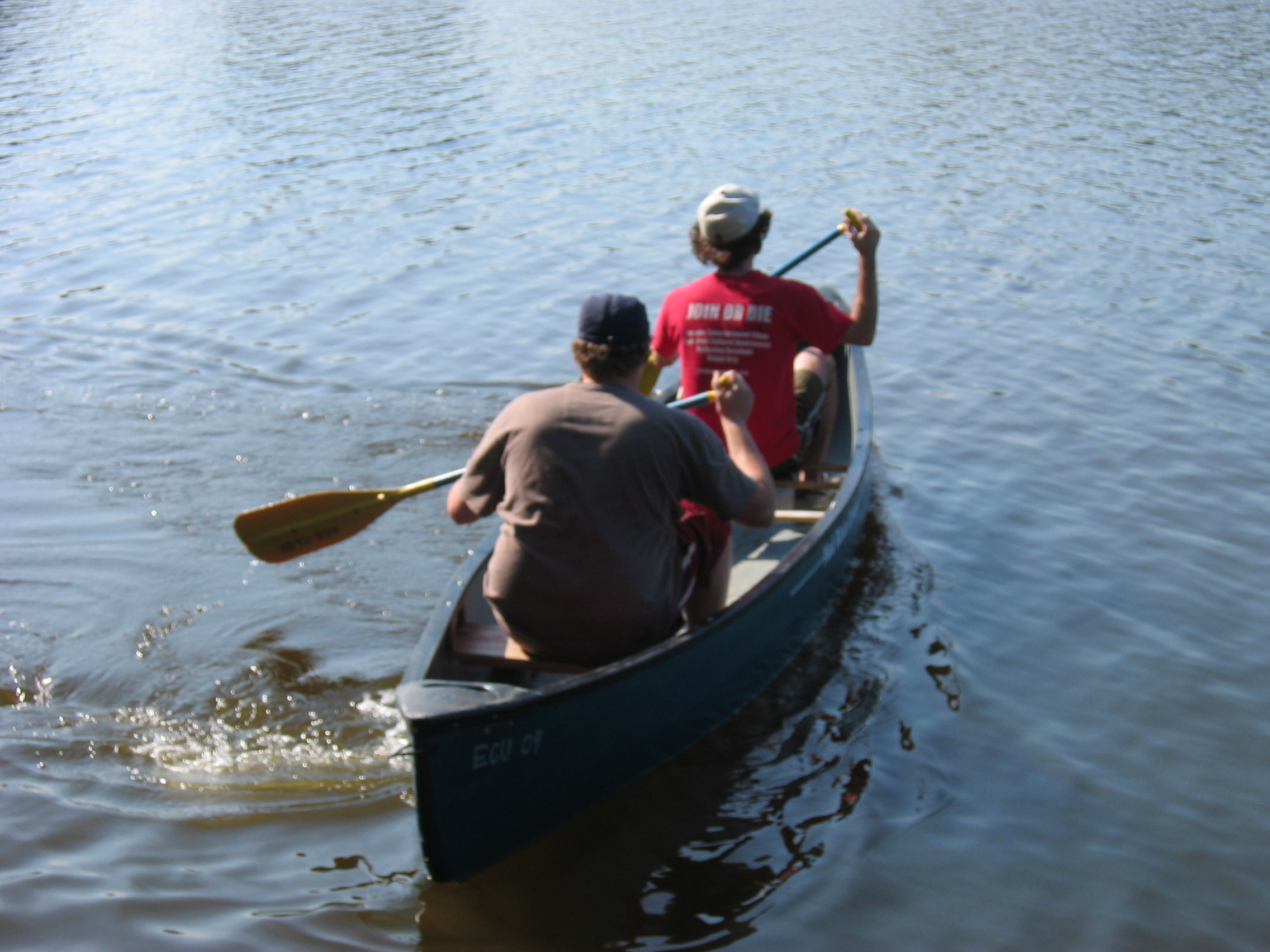
I’ll close this post with one of my favorite photos.  A few years ago, some of the students in our group organized their own camping trip.  Those who went kept talking about what a moment of rest it was, despite the campfire that wouldn’t get going and the bugs and the heat.  One day they rented canoes and just set out in the calm of North Carolina’s eastern rivers.  And on that day, they rested.  If only we could make a commitment to this.

* Donna Frietas’ interview with Patheos:  http://www.patheos.com/Resources/Additional-Resources/Sex-on-Campus-An-Interview-with-Donna-Freitas.html