Archive for the ‘Uncategorized’ Category

Sabbath-keeping

Last month I meant to post some of the ideas the college students shared about keeping Sabbath time.  I think these are all great ideas for carving out a Sabbath in the midst of everything else. I guess the big challenge for students, and everyone really, is to make an even greater commitment to Sabbath and spiritual development.
Here goes:
  • Attend a meditative worship service (such as the Compline service sponsored by another local campus ministry)
  • Create a Sunday ritual, such as worship at the 11 am service and going out for a leisurely lunch afterward
  • Nature walks, or just quiet walks around campus during a less-busy time (but not at night!)
  • Healthy recreation, fun and games
  • Talking to God at night when you lie down in bed, until you drop off to sleep.  Pretty neat that your last thought before sleep is a prayer rather than a worry.
  • Reading good books and passing them around within your group of friends
  • A small group Bible study NOT led by an “expert”
  • Praying while you do menial everyday tasks
  • Listening to prayer podcasts (one student’s favorite is here (it’s called “Pray As You Go”)
I’ll post more as we continue to talk about this.

God moment

In Bill Moyers’ PBS series on Genesis, Dr. Renita Weems gives her definition of a miracle.  I don’t have her exact words, but she says that a miracle is receiving something you needed just when you needed it.  It may have another, more scientific explanation.  But to you, the miracle is God intervening in your life at a certain point in time, in such a way as to briefly erase the line between heaven and earth.  The modern parlance for miracle seems to be the term “God moment”:  I hear people using this term often to describe a moment when they were fulfilled, or made aware of God’s presence, or both.

Well, if there ever was a miracle, or a God moment, I’m watching it right now in a tiny window on my computer screen.  It’s been hard to sleep and work ever since the rescue of the Chilean miners began last night.

I realized this morning, after a few brief hours of sleep, how many “moments” I’ve seen unfold right before my eyes on live TV.  Some of these were miraculous, others disastrous.  In fact, just about my entire time in ministry has been punctuated by these huge moments that everyone gets to watch.  Here are a few items from my list:

  • September 11
  • The invasion of Iraq in 2003
  • Recent large-scale natural disasters (tsunami, Katrina, earthquake in Haiti, floods in Pakistan)  — even if TV crews weren’t there at the precise moment of disaster, they converged on the scene in record time.
  • And of course, the mine rescue.  I just can’t get over how calm the miners are as they wait those last few seconds in the capsule.  They wait with the patience of Job until they are unharnessed and able to kiss their loved ones.

Are all of these God moments?  In a way, yes.  In seminary we used to talk about “liminal moments”:  experiences that blur the boundaries between God and people, eternal and temporal, holy and ordinary.  A liminal moment is when something extraordinary is happening, and you sense the power of God in an overwhelming way.  You can have a liminal moment in a time of great rejoicing, or of deep suffering.

I think I need to pay more attention to these moments.  As long as we have instant access to photos and video from almost anywhere in the world, we’ll be able to watch as people experience life-changing moments.   And we’ll most likely feel intense emotion, even though we are far from the action.  (I wonder if TV also increases our feelings of empathy and the inevitable feelings of helplessness that go along with it.)  We have a totally new way of experiencing the presence of God, and I’m not totally sure what that means yet.  Through technology we are drawn in with others in a way that was impossible during the time of Abraham, David, Jesus, Paul, Constantine, or Luther (or Calvin!)  Would the founders of our faith know what to do with all this information?

Anyway, I’m going to quit writing so I can watch more miners emerge from the pit.  I’m anxious to see how this God moment develops, both in the lives of the people in Chile and in all those who are drawn in by TV and prayer.

Postscript:  here’s a link to a great photo page on CNN (scroll down until you see a photo of the back of a man wearing a beige T-shirt.)  If I’m translating it right, the back of the miner’s shirt reads:

“For the depths of the earth are in his hands, and the heights of the mountains are his.”  In Him is the honor and the glory.

just a little bit

I’ve always believed in the power of little things.  Yes, it sounds sentimental, like a motivational poster with a picture of a butterfly or something (“One little flutter of a butterfly’s wings….”) Blech.

It’s just that in my way of thinking, getting the big things right is impossible unless I start small.  And in my experience, if I forget about the small stuff, my whole life gets out of balance.

Over the weekend I found myself re-converted to my belief.  Last Thursday night, the college students shared ideas on taking a Sabbath rest.  (Most of the folks in the room admitted to already being tired this early in the semester!)

It struck me how all the ideas being batted around the room were so, well, little.  The activities the students described were rich and meaningful, but just … short.  This is no criticism of the students!  They are simply part of a larger society that seems to have no use for big commitments anymore.

In fact, as I mulled over our discussion, I remembered some other things I’ve read, suggesting that people of faith try something little.  Donna Freitas, author of Sex and the Soul: Juggling Sexuality, Spirituality, Romance and Religion on America’s College Campuses recommended in a recent interview* that students try temporary abstinence from sex.  She wondered if short periods of abstinence might lead to a greater commitment, once students have a breather from worrying about sexual performance and have a chance to rest in their own beds.  Somewhere else (but I can’t remember where) I read a suggestion that Christians try small bits of “fasting” or “abstinence” from things like TV or junk food.  Even the secular magazines I read regularly have articles about cutting down on meat or gasoline or some other commodity, but not cutting it out entirely.

Only one student in that group brought up the concept of a total Sabbath.  Her relatives had been farmers, and they took Sundays off. No cooking (cold leftovers for all three meals), no laundry, no cleaning.  They just got dressed, went to church, visited relatives, and probably washed the dishes.  (I can’t imagine a Southern woman leaving dishes in the sink overnight!)

Wow.  I guess this is where we are as a society.  Sometimes I think the only true commitment we make is to our cell phones.  We’re accessible 24/7, ready to go over tomorrow’s meeting with the boss while we cook dinner, or to check Facebook while we supposedly have lunch with our significant other.

Other than the phone, what commands our true commitment?  Work?  Hmm… everyone checks Facebook at work too.  Marriage?  I wonder if there would be so many marriage books on the market if couples just took a little more time to talk.  Taking care of our bodies?  As long as I can do it in 10 minutes or less!  Taking care of our souls?  Um, maybe later when things calm down at work/school/whatever.

Of course I still believe in the little things.  I really like Donna Freitas’ suggestion.  Also, later on, I’m going to post some of the Sabbath ideas shared by the students.  Maybe these little things can help us rearrange our commitments.

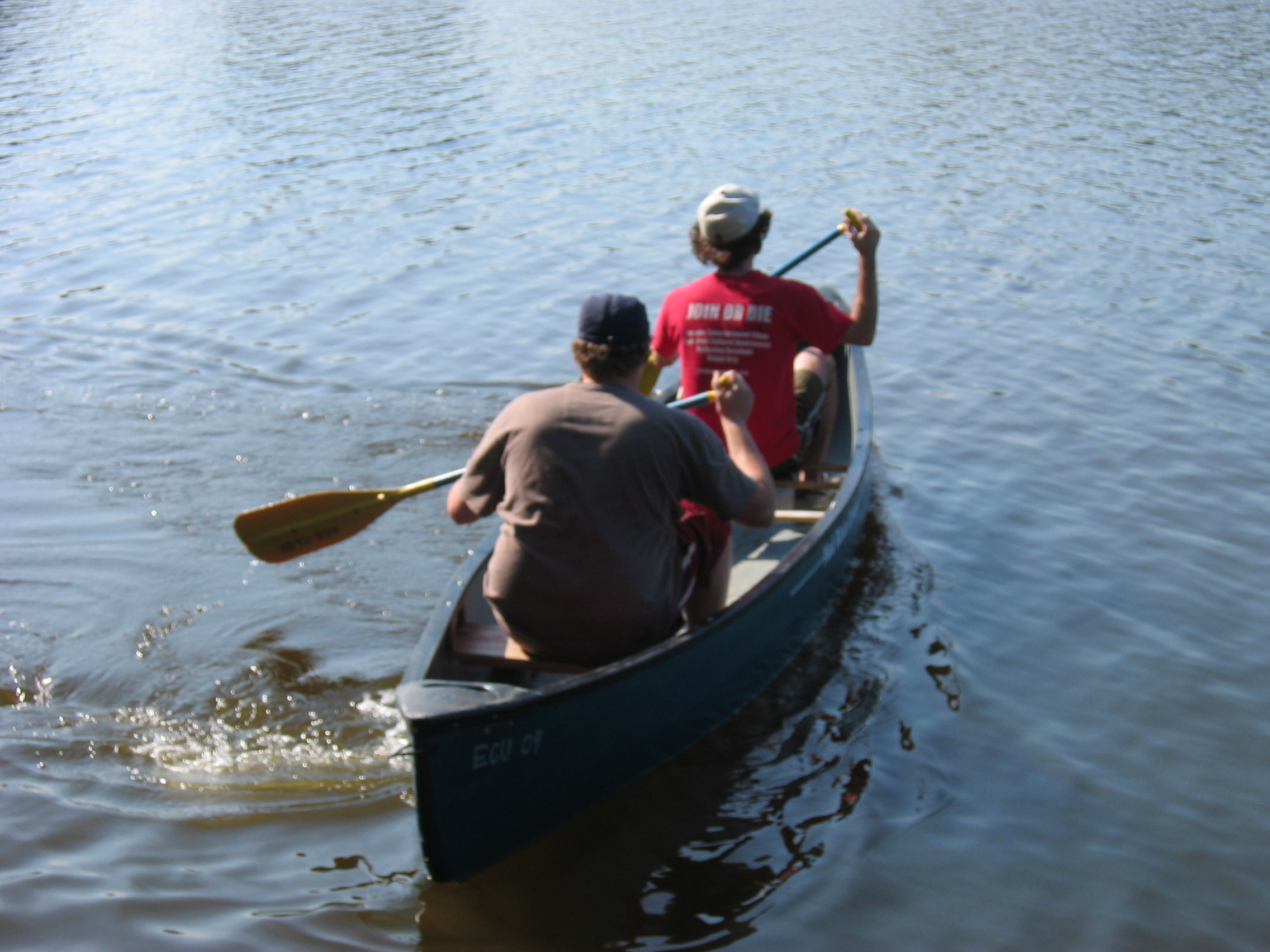
I’ll close this post with one of my favorite photos.  A few years ago, some of the students in our group organized their own camping trip.  Those who went kept talking about what a moment of rest it was, despite the campfire that wouldn’t get going and the bugs and the heat.  One day they rented canoes and just set out in the calm of North Carolina’s eastern rivers.  And on that day, they rested.  If only we could make a commitment to this.

* Donna Frietas’ interview with Patheos:  http://www.patheos.com/Resources/Additional-Resources/Sex-on-Campus-An-Interview-with-Donna-Freitas.html

lost symbols

Landon Whitsitt, the Vice Moderator of the Presbyterian Church (USA) used a great word to describe what I’m writing about today: kerfuffle. And I’m about to add to it!

The excitement is over some recent articles on clergy burnout in the New York Times (click here and here) and in the Huffington Post (click here.) Each article offers some insight into the problems of clergy and congregations falling short of their goals (and the gospel.)

I’m beginning to wonder if part of the problem is symbolism. Whether we care to admit it, symbols and the meanings we attach to them have a huge impact on our beliefs, opinions, and everyday activities.

I grew up with grandfatherly pastors who carried out their ministry in beautiful, historic buildings. Although I’ve had a variety of church experiences since my childhood, I have to admit that those symbols hold a lot of meaning for me. My thoughts of the kind silver-haired man and the musty old building evoke a feeling of being grounded and connected. Moreover, I grew up watching M*A*S*H (yes, that dates me) on TV, and enjoyed watching the meek and scrappy Father Mulcahy.

Anyone who has gone to church for several years has developed a relationship with symbols as well, even though some would ardently deny it. Churchgoers have fond or painful memories that become entrenched in their minds: memories of pastors, places, songs, and experiences.

Unfortunately, some of the symbols we hold on to so tightly are incomplete, or even obsolete. Yet we still hold on to them, thinking that if we can just find a person or place that fulfills the symbol, God will smile on us and things will be great.

One of the symbols most appealing to mainline Protestants is that of the young male pastor with a pretty wife and smiling children. I can understand why this symbol is so powerful. After all, a beautiful family greeting people outside the church after Sunday worship sort of looks like a Nativity scene, and who doesn’t like Christmas? Maybe that’s why I have fond memories of the older pastor: he looked like a Santa decoration we had at home.

The problem is that God calls people, not scenery or statues or stereotypes. And the essence of God is deeper than the trappings we assign to it. All people of faith burn out, or just slowly simmer into nothingness, when the scenery becomes the main object of worship. When clergy have trouble breaking out of their role as props, they are bound to feel worn down. When congregations can’t see past the decorations, they are bound to become petty and lacking in purpose.

How do we fix this problem? Some denominations have a tradition of assigning pastors to churches instead of allowing the churches to choose, but I’ve even heard of churches seething and waiting until they get assigned a “real” pastor who fits the mold they want.

Maybe it’s as simple as choosing more meaningful symbols. How could Christians go wrong if we focused more on the cross, the cup, the bread, the empty tomb, and the flames of Pentecost? In trying to fit our faith into a box, we create our own coffin: in the ancient symbols of faith we may just find something that helps us break out into life.

empty space

Earlier this summer a friend sent me this aerial photo from Afghanistan.  It shows an empty space.  Years ago, folks carved a gigantic statue of the Buddha out of the rock of this mountain, and the statue (and others like it) stood silently through years of human history and all the good and bad that humans do.  In 2001, however, the Taliban decided the statues had to go, and dynamited them.  Thus the empty space.

imagine if someone did this to Mount Rushmore...

Aside from the issues of religious tolerance, human rights, and cultural preservation, this photo brings up a ton of questions for me about spirituality and religious expression.

First and foremost, don’t you feel a sense of grief when you look at this picture?  Regardless of your personal beliefs, does it not hurt to see evidence of humans trampling all over one another, and leaving open wounds in bodies as well as landscapes?

Second, this picture made me think about empty spaces I see in my own environment.  Some of them are tangible, like places that were flooded during Hurricane Floyd in 1999 and never rebuilt.  Some of them are intangible, like the spiritual empty spaces I encounter as a pastor:  places in people’s lives where there is an unresolved loss, an unfilled longing, or even an open wound.  Sometimes as a pastor I get to see empty spaces that people have brought upon themselves.  When you get to those places you are in a type of sacred space (maybe you could call it a “decision space,”) such as Moses encountered at the burning bush.  The empty spaces call out for some kind of action, even if just to remain empty for a while.  I read somewhere that efforts are underway to re-sculpt the statues, but for now the empty spaces have a lot to say on their own.

Third, I think about my job that’s coming up in a few weeks, to create some kind of sacred space for college students as they begin a new academic year.  As always, I selfishly enjoy having a large group of students, and hope that God sees fit to send the students we contacted at orientation our way!  More than that, I am always in prayer at this time of year over how to juggle truth, tolerance, idolatry, and emptiness as I work with these great folks.

I’ve noticed along the way that some people choose one of these three options when working with college students:

1.  Present Christian faith as rock-solid, written in stone, unchanging as the mountains into which we carve statues. But that’s not telling the truth.  Indeed, God is solid, the rock on which we can build a foundation (see Matthew 7:24-27.)  Yet our relationship with God, as individuals and as a church, changes.  I think we can say with authority that faith is not the mountain, but that it can move one (see Matthew 17:20-21.)

2.  Tear down everything students have been taught, using intellectual dynamite if needed. This also strikes me as dishonest.  The world’s best ideas are products of a complex process that involves tinkering, debating, critiquing, researching, and sometimes even poaching.  Perhaps some students need to have a rigorous initiation into the practice of thinking as an adult.  But I haven’t met anyone yet who developed a strong intellect and solid moral character via intellectual annihilation.

3.  Don’t say anything, and let folks figure it out for themselves. Also not a good option.  After all, why are college students even in school, if not for some guidance on how to get a life?  And if professors or RA’s or campus ministers truly believe the students are putting their faith in the wrong things, how can they be silent?

So I’ve got a lot of space to work with.  What are you doing with yours?

nametag revolution

When you were little, what did you want to be when you grew up?

Your dreams were probably shaped by the world around you and its expectations, but you probably also had some kind of developing value system that influenced your dreams.  Early on, you were dreaming of adventure, or security, or being recognized, or being helpful.

There is an article in the latest edition of the Atlantic Monthly on the rise of women in the workforce.  Some experts say that the current hot fields are more receptive to women’s “nurturing” and “collaborative” nature (I am really leery of making generalizations like that), and some say that women are just getting stuff done more than men.

Regardless, it seems to me, a non-expert observer, that we are in for a revolution led by those wearing name tags.  Many of the hot jobs have varying educational requirements, but across the board they all require a name tag or badge: a hospital ID pinned to your scrubs, dog tags to go with your military uniform, or the white nametag sewn over the breast pocket of your blue coveralls.  Here at ECU, many students are majoring in education and construction management, so we’ll see their names on classroom doors, or see them wearing polos embroidered with the construction firm’s logo.  This article from Yahoo points to an increase in tech jobs, but also reminds us that laborers, technicians, beauticians, and people who fix things will continue to be much in demand.

my name tag for Sunday mornings

When I was in college in the 1990s, many of us students visualized sitting in a cubicle sometime in the future, living out a scenario much like the movie “Office Space.”  Now I work with several students who are looking at two extremes:  going on for extensive professional training in health care or technology, or dropping out of college to learn a trade.

What does this mean for the ideas of vocation and calling, ideas that we toss around a lot in ministry with young people?  Does it mean that some people won’t be able to live out their true vocation, because the “New Economy” calls for something different?  Does it mean that we each need to find our vocation wherever we are, regardless of what our name tags say?  Does it mean we should examine our assumptions about vocation, such as thinking that finding one will make us endlessly happy?  (see this “Faith and Leadership” article from Duke.)

Well, when I was little I wanted to be an artist, astronaut, writer, and pastor.  I don’t think my name tag reflects all that, and I probably won’t get around to all those things.  But I hope I can help people as they prepare to put on their tag for the first time.

now is the time to worship

For the first time in a while, someone approached me after the 8:30 am service at First Presbyterian, and instead of complimenting my sermon, she complimented the entire worship service.

That was the best thing I’ve heard all week!  I know the Reformed tradition(s) put  a lot of emphasis on reading and teaching the Word, but hey, worship should be important to us too.

The Sunday before, the importance of worship came rushing in upon me like a gale-force wind.  I was attending the opening worship of the 219th General Assembly of the Presbyterian Church (USA) in Minneapolis.  At the beginning of the service, as I saw Commissioned Lay Pastor Fern Cloud ascend to the pulpit, and as we were surrounded by sights and sounds invoking a Native American spiritual experience, it was almost impossible for me to hold back tears.  The service went on to include other musical traditions, and the great feeling just continued.

Why?  Am I just sentimental, swimming in romantic nostalgia for a people and way of life to which I don’t belong?  It’s possible, but I don’t think so.  What I felt was more like relief.
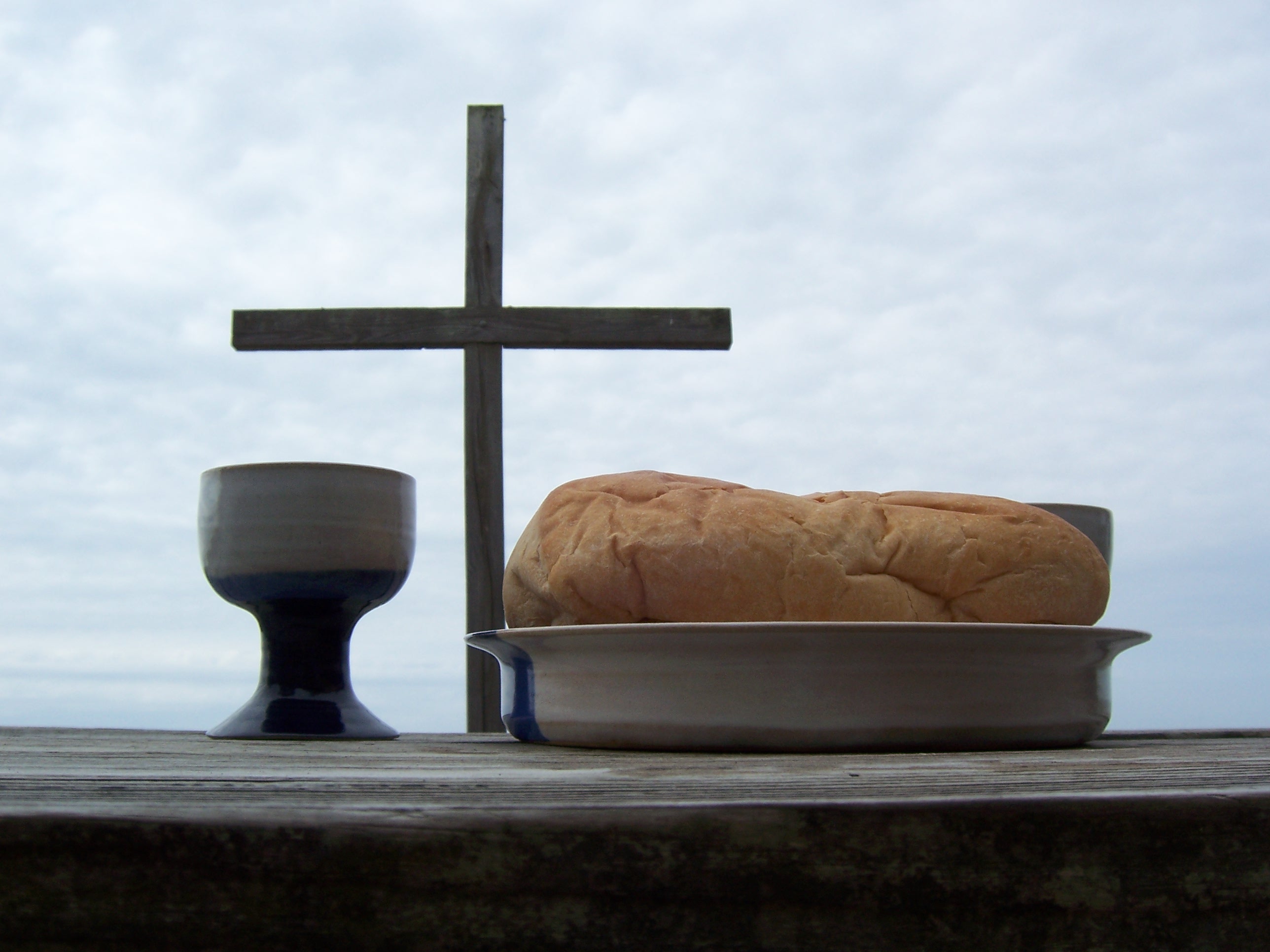
worship by the Bogue Sound, with borrowed communion set

Many times I have experienced worship as if it were a package, neatly wrapped and delivered to my lap.  I’ve been to churches that delivered me a fire-and-brimstone package, or an intellectual sermon-and-classical music package, or a fun and inspirational package, complete with scruffy-looking young men playing electric guitars.

Problem is, when I have received those packages, I have found that all the work has been done for me.  I’ve been told what to think, what to feel, and how to express myself.  And after a while I feel stifled, jittery, and far removed from God’s presence.

But things were a little different at the General Assembly service, and at our 8:30 am service here in eastern NC.  In both these situations, the worship incorporated what local people had to offer, instead of fitting themselves into a pre-packaged mold, and I think that makes all the difference.

It makes perfect sense when you have a big church conference to honor the resources and traditions of all the local churches.  And it is a breath of fresh air here in Greenville to see what kinds of musicians might show up at the 8:30 service.  We have a great school of music at ECU, and lots of local people have musical talent.  So we might have a piano, guitar, bass, flute, mandolin, trumpet, or who knows what to lead us in worship.

In seminary we learned that the original “offering” in Christian worship consisted of people bringing communion bread, wine, flowers, oil for anointing, or whatever was needed for the service that day.  Read 1 Corinthians 12 and you’ll learn more about the emerging tradition of people offering various spiritual gifts.  The early Christians had no one they could hire, or anyone they could fully copy.  There was no package they could wrap up for their members–they were creating worship as they went along.

So I can understand why the church member was inspired by the early service.  The music was authentic, and it came from within our community.  It didn’t have a brand name or particular style.

Worship that incorporates what the community has to offer takes me out of my little bubble and into a wider world–and then it challenges me to do something with what I’ve been given.  So now I’m challenged to think beyond the music here in our congregation, and to think more about worship experiences our campus ministry will have.  I’ve been given the gift of great people all around me.  Instead of trying to deliver them a package, how can I help them bring their gifts to the table?
you can’t love until…

In my last blog post I wrote about what we put into our systems of body, mind, and spirit. I mentioned that my ruminating on this subject began with an article in the campus paper.

I wish I’d written something right when the article came out, because I don’t see it in the archives anymore. Anyway, there is a regular sexuality column in the paper, full of advice on relationships and intimacy. A few months ago, the author gave the advice that one should take a break from sex after breaking up with a boyfriend/girlfriend, so as to “heal” and build up self-esteem. The author referenced the conventional wisdom that “you can’t really love someone until you love yourself.”

Now, before I say anything else, let me add a qualifier here. I believe there are plenty of occasions that warrant time for recovery, healing, and self-preservation. You cannot have a healthy relationship if you are continually caught in cycles of abuse, or if you are completely unable to stand up for yourself.

That being said, I think I smell garbage.

As a culture, we pretend that love is a reward for working hard. We pretend that “serial monogamy,” the practice of having one exclusive sexual relationship after another, is a good way to prepare for marriage and family life. We pretend that when a young tender heart is broken, it can fully recover in just six short steps. Perhaps worst of all, we pretend that only those who are perfect have the right to be loved.

Basically, we give young adults a minefield of mixed messages: go out and do things that might cause you pain, but don’t let any of that pain show because then you’ll be out of the game. Expose yourself in the hopes that you’ll be rewarded with affection. And have fun, kiddos! This philosophy just creates a generation of tired, numb, and scarred people.

In about ten days I’ll be preaching on Romans 5: “suffering produces endurance, and endurance produces character, and character produces hope, and hope does not disappoint us, because God’s love has been poured into our hearts through the Holy Spirit that has been given to us.” (from verses 3-5) I propose that instead of listening to the garbage our culture tells us about relationships, we look instead to God’s philosophy:

  • Take the risk of loving others because you are already loved, and because you want to share what you already have, not because you hope to purchase someone’s love.
  • Feel good about yourself because you are already loved, not because you forced yourself to seem impervious to pain.
  • When pain strikes, rather than hoping for “healing” and warm fuzzy feelings, strive instead to develop endurance and character.

There are some scholars working on the interrelated issues of sexuality, spirituality, and health: Lauren Winner and Donna Freitas come to mind. I hope that this discussion gets more publicity in the near future. One of the hardest parts of my job is walking with students through the spiritual morass of being twenty years old and already having four or five failed relationships, all resulting from just trying to follow supposedly good advice. I hope to spend more time talking about how we are already worthy and already loved. The last thing we need is less love.

GIGO

Back in the 1980s when my father worked for IBM, I went through a science-nerd phase.  I took a computer class in BASIC (hah!) and went to Space Camp twice.  Those were the days…

Anyway, I loved the little phrase the teacher gave us in our class.  “Garbage In, Garbage Out”  or “GIGO” was a recurring theme of the class.  In other words, watch what you put into your computer program, because that’s exactly what you’ll get when it runs.

Recently this little phrase has taken on new meaning for me.  It all started a few months ago with an article in the campus paper (see an upcoming blog post for this.)  Since then, everywhere I go, I’ve been noticing garbage!  Not the tangible kind that you put in a can, but the philosophical, emotional and spiritual kind:  the junk we put into our systems because it makes us feel good, or because we have been told that it’s good.

Once I saw a bumper sticker that read, “The definition of insanity is doing the same thing over and over again and expecting different results.”  We humans have a sad knack for expecting peace and happiness while we pollute ourselves body, mind, and soul with junk.

I have a few blog posts in the works on this, and I might even make a theme for some campus ministry discussions out of this.  (Maybe we could contrast GIGO and TITO–Truth In and Truth Out?  or HIHO–Health In and Health Out?  Nah, too dorky.  But I could think of these goofy acronyms all day…)

I’m privileged to work with a group of great students who are smack-dab in the middle of figuring out for themselves what is garbage, what is treasure, what is truth, and what is a lie.  My prayer for them, and for all of us, is that we’ll be able to see the garbage for what it is and throw it out.

more New Mexico videos

River cleanup:   http://tiny.cc/PElIL and http://tiny.cc/xoIT7

John Stephenson, founder of the Santa Fe Community Farm.  John is now 95 years old and has received numerous awards for his work on the farm, as well as weightlifting.   http://tiny.cc/5c7Rv and  http://tiny.cc/fc7iI